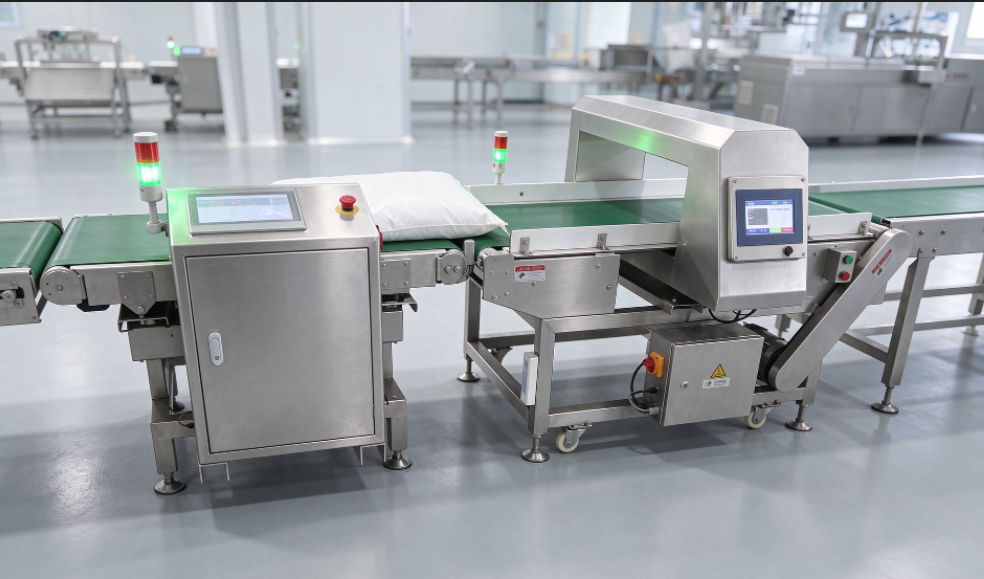
How to choose the conveyor metal detector
1. Define the application.
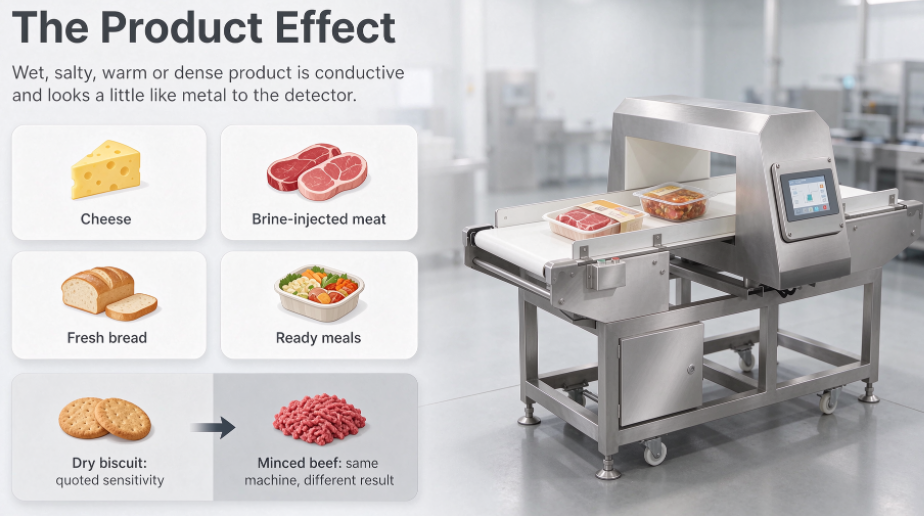
A metal detector with an Fe sensitivity of 0.5 mm for biscuits may not even achieve Fe 2.0 mm when inspecting brined meat products.
Product type: dry, wet, frozen, salty, hot, packaged, bulk, etc.
(Lower frequencies penetrate deeper and suit bulkier or denser products; higher frequencies improve sensitivity to small contaminants, especially non-ferrous and stainless steel.)
Industry: food, pharmaceutical, chemical, packaging.
Purpose: quality control, food safety, HACCP/CCP, customer requirement.
Check if a metal detector is suitable—if the product is in metallized film/foil, use an X-ray system or specialized detector instead.
2. Packaging Material
Packaging type is an important selection factor.
| Packaging | Recommended Inspection |
|---|
| Plastic bags | Conventional metal detector |
| Paper cartons | Conventional metal detector |
| Glass containers | Metal detector, subject to line design |
| Aluminum foil packaging | Specialized ferrous-in-foil solution or X-ray inspection |
| Metallized film | Specialized metal detection or X-ray evaluation |
Important: Conventional metal detectors may not work properly through aluminum foil or metalized packaging because the packaging itself can produce a strong signal.
For these applications, an X-ray inspection system or a suitable specialized metal detector should be evaluated.
3. Identify the target contaminants and required sensitivity
Typical targets: ferrous, non-ferrous, stainless steel.
Required sensitivity usually specified as mm sphere sizes, e.g. Fe 1.5 mm, Non-Fe 2.0 mm, SS 2.5 mm.
Confirm the sensitivity with your actual product, not only with air tests.
4. Measure the product and conveyor requirements
Product height, width, length, weight.
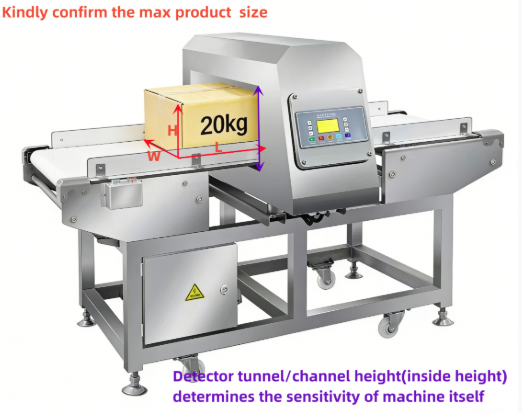
Required aperture size: product height + clearance; belt width + clearance.
Conveyor speed and throughput.
Belt type: food-grade, cut-resistant, anti-static, cleated, etc.
Line height and available space.
* Aperture (Detector head/window inside size.)
The aperture should be sized to the product with minimal clearance—not oversized “just in case.”
Sensitivity is tied directly to aperture size: the larger the opening, the farther the search head coils sit from the product at the center,
and the worse the detection.
A 100×100 mm aperture will detect a smaller contaminant than a 600×250 mm aperture using the same detector technology
5. Installation Space and Production Line Integration
Before purchasing, confirm:
Conveyor working height.
Available installation space.
Infeed and outfeed conveyor dimensions.
Electrical power requirements.
Production line communication requirements.
Cleaning and maintenance conditions.
Our engineering team can customize the conveyor structure, detection aperture, rejection system, and control functions according to your production line.
| Selection Factors | Key Points |
|---|
| 1. Product Application | Product type: Dry, wet, frozen, salty, hot, bulk or packaged. |
| 2. Packaging Material | Plastic, paper, glass, aluminum foil or metallized film. |
| 3. Detection Sensitivity | Target metals: Fe, Non-Fe and SUS304/316. Define required test sphere sizes and verify with actual products. |
| 4. Product & Conveyor Size | Product L × W × H, weight, conveyor speed, belt width and required aperture size. |
| 5. Installation & Integration | Working height, available space, power supply, rejection system, cleaning and production line connections. |