| Section | Required Information |
|---|
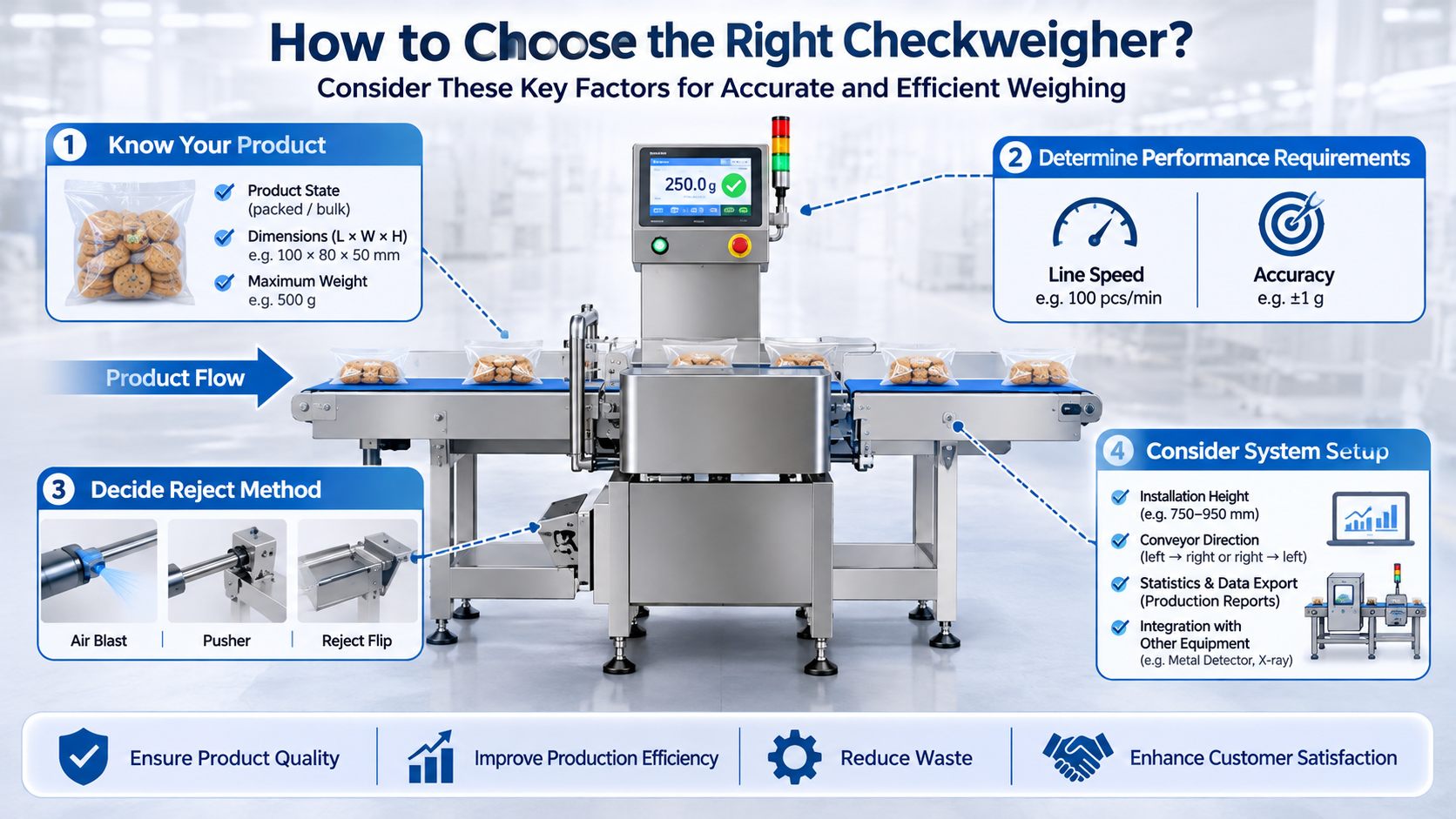
| 1. Product | Product type, state, length × width × height, maximum weight |
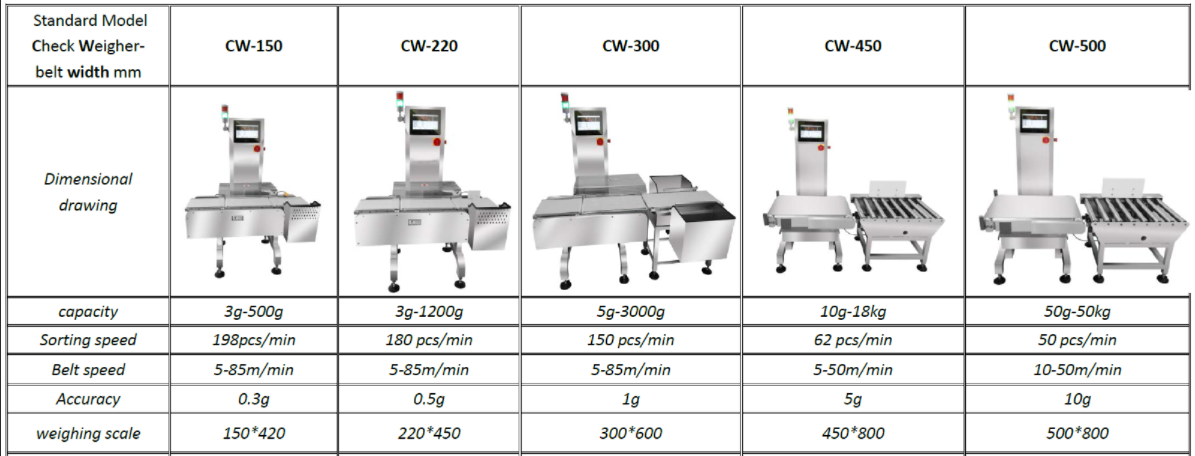
| 2. Speed & Accuracy | Line speed (pcs/min), weighing accuracy (e.g. ±1 g), weighing range |
| 3. Reject System | Rejection method for unqualified products, discharge direction, collection & confirmation |
| 4. Integration | Operating height, conveying direction, statistics functions, connected equipment, power & environment |
How to Choose a Checkweigher: What to Compare and Evaluate
Quick Overview
A good checkweigher is not simply the one with the highest stated accuracy. What matters most is whether it can weigh consistently and reliably under your actual product weight, line speed, and workshop conditions, and reliably reject out-of-spec products.
Key Takeaway: Accuracy Should Be Fit for Purpose, Not Overstated
Chasing the highest accuracy often leads to higher equipment cost, lower checkweighing speed, and stricter requirements for installation conditions and product stability — which can become a bottleneck for the whole line. The right approach is to leave a safe margin based on your product tolerance: matching the working conditions matters more than the highest paper accuracy.
Eight Points to Compare When Evaluating a Checkweigher
| No. | Evaluation Point | What to Check |
|---|
| 1 | Dynamic accuracy & repeatability | Whether it weighs accurately while products are moving on the conveyor; whether the deviation stays stable and tight across repeated weighings of the same product. Repeatability matters more than a single nominal accuracy figure. |
| 2 | Weighing range matching | Whether the minimum and maximum capacity covers your product weight. Too wide a range dilutes accuracy for light products; too narrow a range risks out-of-range errors for heavy items. |
| 3 | Speed–accuracy balance | The actual accuracy at your line's pieces-per-minute rate, and how much accuracy drops when the speed increases. |
| 4 | Sensor & algorithm | Sensor type, resolution, sampling rate, and the filtering, anti-sway, and temperature-drift compensation capabilities. |
| 5 | Mechanical construction & materials | Rigid frame, flat and non-tracking belt, guiding and vibration-damping design; for food applications, washdown capability and food-contact-grade materials. |
| 6 | Environmental adaptability | IP rating, washdown resistance, and tolerance to workshop vibration, dust, and moisture. |
| 7 | Rejection system reliability | Reject method, response speed, rejection accuracy, plus alarm for missed rejects, waste collection, and re-checking measures. |
| 8 | Software features & after-sales support | Weight recording, statistics and reports, data export and communication interfaces; certification, spare parts availability, and service response time. |
Don't Judge Accuracy by a Single "±X g" Figure
When confirming accuracy with the supplier, make sure the following conditions are clear:
Dynamic accuracy: accuracy measured during in-motion weighing, not static no-load accuracy.
Repeatability: whether the deviation stays consistent and stable across repeated weighings of the same product.
Range and speed: the weighing range and checkweighing speed that the accuracy figure corresponds to; accuracy without these two conditions is meaningless.
Process capability: for critical applications, request Cpk data (generally recommended ≥ 1.33) to confirm the accuracy has a safe margin.
Rule of thumb: the checkweigher accuracy should generally be about 1/3 to 1/4 of the product tolerance. For example, if the product tolerance is ±3 g, a checkweigher in the ±1 g range is usually sufficient; there is no need to go to ±0.1 g.
Typical Accuracy Levels by Product
| Typical Product | Common Accuracy Range | Notes |
|---|
| Seasoning sachets, tablets, small powder pouches | ±0.1 g level | High-precision sensors are only needed for light, small items |
| Snack bags, instant noodles, bottled beverages | ±0.5–1 g | Mainstream range for food packaging |
| Medium boxes/bags, cans | ±1–5 g | Balances speed and stability |
| Full cases, bulk bags | ±5 g and above | High precision is neither economical nor necessary |
Selection Summary
First define the product weight, allowable tolerance, and line speed → then compare dynamic accuracy, repeatability, and rejection reliability under those working conditions → finally weigh up mechanical construction, environmental protection, software features, and after-sales support. Match accuracy to the tolerance with a safe margin, and prioritize equipment that is stable over the long term, easy to maintain, and backed by reliable service.